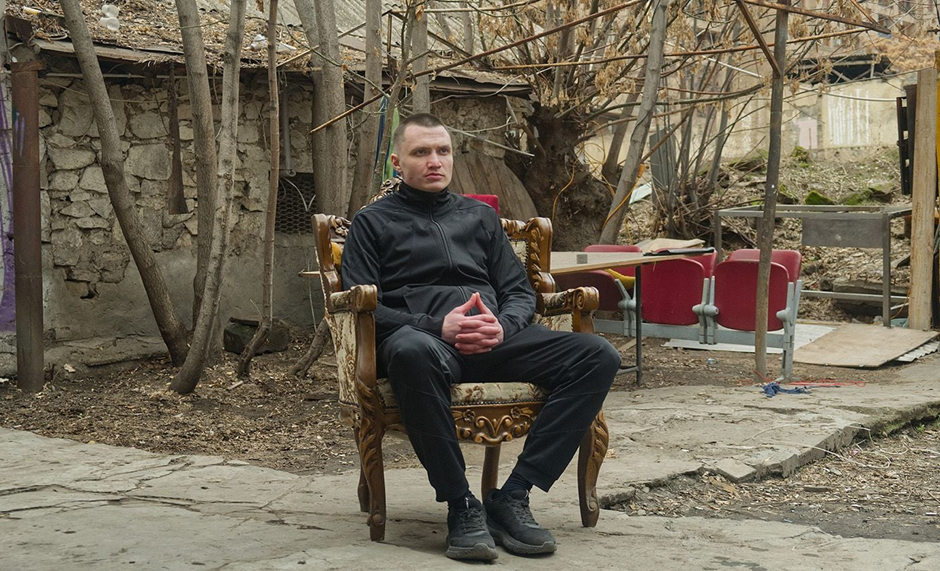
Anton Lysov is 26 years old. The last five years of his life have felt like something out of a horror film. A native of Cheboksary, a city in Russia’s Volga region, he has passed through the KGB pre-trial detention centre in Minsk, endured torture by Belarusian security forces, been transferred between prisons across Russia, and survived 21 days in a concrete basement near Vovchansk, a town in northeastern Ukraine near the Russian border.
Anton is now in Armenia and, for the first time in years, says he finally feels safe.

Left: Anton Lysov in 2021, photo from his Instagram account.
Right: March 3, 2026. Photo: Egor Kirillov / Mediazona.
A “Political Mess” in Minsk
In 2021 Lysov found an order on the darknet: burn a Toyota Land Cruiser in Minsk for $2,000. He says he did not think about politics — he simply needed the money.
On October 1 the car was set on fire and burned completely. Only later did it emerge that the vehicle belonged to Major General Aleksei Volkov, head of the Belarusian State Forensic Examination Committee, an official involved in cases against opposition figure Sergei Tikhanovsky.
Lysov was detained just eleven hours later.
Only then did he realise the scale of what awaited him.
“They tortured me again and again — asking who I was, what I knew. I said I didn’t know anything… but in Belarus that doesn’t matter. There is no justice there at all. I ended up caught in a political mess. If I had been Belarusian, they probably would have just hanged me in the forest. That’s what they told me when they arrested me — that they could simply take me out to the woods right now and finish it.”
According to Lysov, Interior Minister Ivan Kubrakov personally came to the department. He pressed on the bruised areas of the detainee’s face and slammed his head against the wall.
“He said: ‘You’re growling, are you, you little bitch? Good.’ Then he smashed my head against the wall and said that if I didn’t confess within twenty minutes, they’d group rape me”
Lysov spent a year and a half in Minsk’s SIZO-1 detention centre, with special registration as an “extremist”. The Belarusian human-rights organisation Viasna recognised him as a political prisoner.
In the end, he was sentenced to ten years in a penal colony.
Before being extradited to Russia, Lysov was transferred to a psychiatric hospital. There he met another political prisoner — the well-known Belarusian artist Ales Pushkin, who would later die in prison.
“He remained idealistic to the very end… they beat him for it, but he never broke. I respect him deeply. He had an incredibly strong core.”
Russian “Solidarity” and the Front
Back in Russia, Lysov says the pressure did not stop. He believes prison operatives subjected him to constant transfers and fabricated new cases out of “solidarity” with the Belarusian general whose car had been burned.
Mentally exhausted, in February 2025 he signed a contract with the Russian Ministry of Defence.
“I didn’t really have a choice except to either die there and finally find peace, or try to escape.”
Twenty-One Days in Hell
In June 2025 Lysov was sent to the front near Vovchansk in Ukraine.
After being wounded almost immediately, a commander ordered him to hold the basement of a destroyed house alone. Ukrainian drones soon blocked the exits.
A grenade blast knocked out several of his teeth and tore through his cheek.
“I told them: I’m rotting alive here, let me leave this place. They said: no, that would be a crime. I smelled like a rotting corpse… I could literally smell my own body rotting. When I woke up, my first thought was to slit my throat to stop the pain.”
Lysov spent 21 days in the basement. He drank water seeping through the soil, ate toothpaste, and lost 40 kilograms.
He was already presumed dead. But eventually he managed to reach his unit by radio and, against all odds, crawl back to Russian lines.
The Escape
After being hospitalised, Lysov says commanders tried to send him back into another assault.
He refused to take up arms.
For that, he says, soldiers tied him to a tree in the forest and beat him for an entire day.
“Like sadists.”
On August 29, Lysov escaped.
By hitchhiking and taking taxis he made his way to his home town Cheboksary, recovered his passport, and managed to leave the country.
Today his face is covered in scars, and repeated concussions sometimes affect his memory.
Yet he is alive — despite two repressive systems that tried to destroy him.