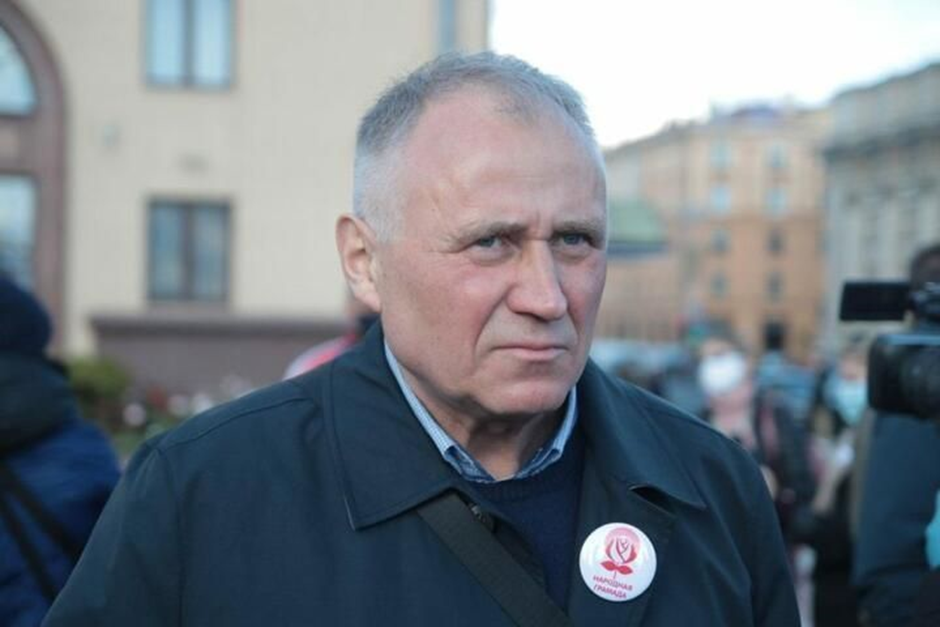
On September 11, 2025, under pressure from the United States of America, the Lukashenkaregime released 52 political prisoners from places of detention. Among them were 12 foreigncitizens. The action was of a forced nature and was accompanied by the immediatedeportation of those released to Lithuania.
To make life as difficult as possible for their opponents in emigration, the authorities sentsome of the individuals across the border without any identification documents at all. However, the security services' large-scale plan to purge the political space through forcedexile encountered the unprecedented resistance of one man. That man is Mikalai Statkevich.
The leader of the Belarusian Social Democracy once again demonstrated the steadfastness ofhis principles. Statkevich categorically refused to leave the territory of Belarus. Despite theauthorities' attempts to squeeze the politician out of the country, they never succeeded inrealizing this scenario.
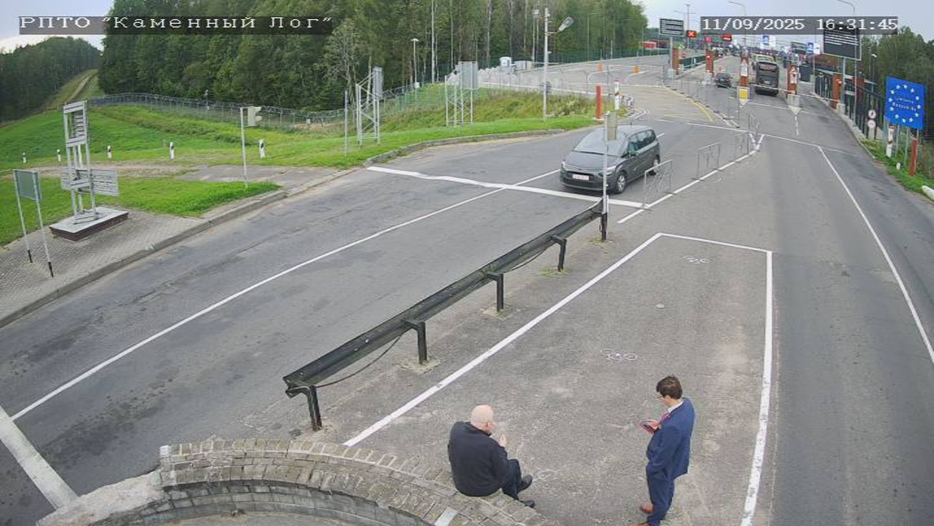

Photo: Mikalai Statkevich sits on the border of Belarus and Lithuania, looking towards his homeland. Kamenny Log, Belarus. September 11, 2025. Screenshot: Gpk.gov.by
Mikalai Statkevich became the only one of the entire group who refused to cross the stateborder. When the bus arrived at the "Kamienny Loh" checkpoint, the politician kicked out thedoor of the vehicle and ended up in the neutral zone. After spending several hours in the grayzone between the two states, security forces detained him and drove him in an unknowndirection deep into the country.
Over the following days, Statkevich's fate remained unknown even to his wife, MarynaAdamovich. On September 15, she officially turned to the police with a missing personreport. That same day, the international human rights organization Amnesty Internationalclassified the incident as an "enforced disappearance."
Maryna Adamovich's attempts to find her husband in the Hlybokaye colony on September 17 ended with the administration's refusal to confirm his presence there. It was later revealed thatthe politician had been returned to the very same colony near Hlybokaye where MikalaiStatkevich had been serving his sentence prior to the "pardon"; however, the authoritiesdeliberately kept him in total information isolation.
The international community's reaction was immediate. The European Parliament Delegationfor relations with Belarus issued a sharp statement, demanding that official Minsk cease thepractice of forced deportation and release the politician.
“The refusal of the Belarusian authorities to disclose his whereabouts and report on hiscondition raises serious concern that he has been returned to custody. This situation isinterpreted as an enforced disappearance—a gross violation of international law, asemphasized by Amnesty International,” the document stressed.
The MEPs also called for the full rehabilitation of former political prisoners:
“We also strongly urge the Belarusian authorities to put an end to the practice of forceddeportation of former political prisoners. All citizens of Belarus must be guaranteed the rightto live and work freely in their country. This requires the full rehabilitation of former politicalprisoners, an immediate end to their persecution and stigmatization, and the adoption ofeffective measures to support their reintegration into society.”
It was not until February 19, 2026, that Mikalai Statkevich was finally released. Thisoccurred only after the 69-year-old politician's health had been completely shattered: whilebehind bars, he suffered a stroke, which caused concern even among the prisonadministration.
Journalist Aksana Kolb managed to speak briefly with Mikalai by phone while he was nearthe border. Statkevich shared that he had also suffered a heart attack while in detention. Hewas fully aware that refusing exile meant an inevitable return to a cell, but his choice wasunyielding:
“If I give in to this now, if I accept their terms, then it means my whole life was in vain.”
Aksana Kolb emphasized that the politician had dedicated his entire conscious life to thestruggle for a better future for the country, and “truly, for him to step down from this lastrung, to turn back when there was only a tiny bit left, that wouldn’t have been Mikalai.”
Mikalai Statkevich's path in the events of recent years began even before the 2020 elections—he was detained on May 31 on his way to a picket in support of Sviatlana Tsikhanouskaya. According to Maryna Adamovich's testimony, men in civilian clothes blocked Statkevich'scar with a van and literally dragged him out of the vehicle.
Statkevich was sentenced to 14 years in prison on charges of organizing mass riots. While incustody, he was subjected to constant pressure: countless terms in SHIZO*, "extremist" status, and the deprivation of parcels and communication with loved ones. The last threeyears were spent in incommunicado mode (absolutely no connection with the outside world, letters, or visits). In total, Statkevich has spent more than 12 years in prison for hisconvictions.
* SHIZO in Belarus is a punishment isolation cell (solitary confinement) in places ofdetention, used as a tool of brutal pressure, torture, and isolation, especially against politicalprisoners. Inmates are kept in extremely cold, cramped cells without mattresses or personalbelongings, often subjected to "carousels" (repeated placement immediately after release). Former prisoners describe the conditions in Belarusian SHIZO as "hell" and a "survivalregime."