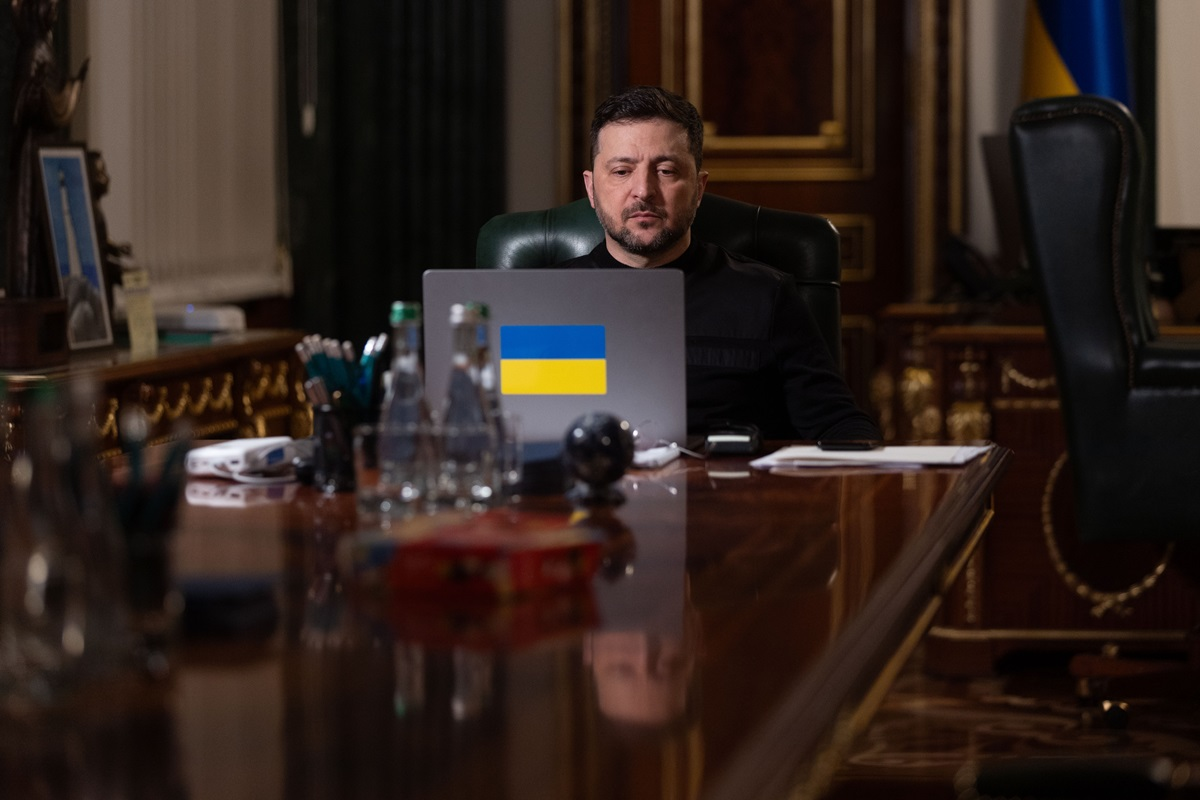
“Zerkalo” has been pursuing this interview for nearly four years — since the very beginning of Russia’s full-scale invasion of Ukraine. For a long time, nothing worked, but we did not despair and continued to remind them of our existence and how important it is for Belarusians to hear an opinion on current events from the leader of a neighboring country. Partly due to persistence, but perhaps even more so due to the Ukrainian authorities' understanding that the Lukashenka regime does not equal the people, this conversation finally took place.
President of Ukraine Volodymyr Zelenskyy told “Zerkalo” when he stopped perceiving Belarusians through the “prism of war” and realized that “we need to communicate,” whether he is ready to help in the release of political prisoners, and how he sees the future of our countries. He also shared information about whether Mikalai Lukashenka actually called him and discussed why it is “cool to talk to Belarusians.”
This conversation took place in two languages: the “Zerkalo” journalist spoke Belarusian, and Volodymyr Zelenskyy responded in Ukrainian.
— Mr. President, immediately after the start of the war, we tried to organize this interview. Probably in dozens of different ways. And now — almost four years later — we are finally talking. Why did you agree specifically now?
— First of all, I want to say openly: I have always treated Belarus and the Belarusian people with great respect; I have been to Belarus many times. But, honestly, after the war started… It wasn't just some kind of offense. We are on the threshold of understanding that not only did Russia start the war, but that the RF has an ally — Belarus. Thank God we are talking about the Lukashenka regime; we are not talking about the Belarusian people. But, nevertheless, when missiles fly, Belarusians must understand that Ukrainians are dying, and for them, Belarus at that moment is an ally of the aggressor, an ally of Russia.
Therefore, to be honest with you, it just wasn't the time for interviews. That’s all. Because I am focused on the war and I perceive Belarus through how it is talked about in this context, how Belarus talks about itself, how Russia talks about it. These are union states, one of which is definitely fighting on our territory and killing our people with its soldiers. And Belarus says that supposedly “we don’t control them [the Russians]” and so on.
At some point, you realize that Belarus probably doesn’t control the Russian army located on your territory, but it’s not *entirely* out of control. Why — I will explain now.
Now we see a new format of relations [between Belarus and the RF], where Belarus knows exactly what is happening on its territory. And it is no longer possible to say, as Lukashenka told me after the start of the full-scale invasion, that missiles flew [into Ukraine], but they “have been standing there for a long time, we don’t control that, we don’t control the launch.” Now, drone relays have appeared on the territory of Belarus, and now this new equipment that appeared there helps Russian “Shaheds” strike our people, the civilian population, and the energy sector, because corrections are being made thanks to these relays.
And the next step is preparing a site for the deployment [in Belarus] of the “Oreshnik” (a missile system and a medium-range ballistic missile of the same name, which Russia uses to strike Ukraine. — *Ed. note*).
These are all new steps; these are not about old actions that didn't depend on Lukashenka, as he claimed. Now it definitely depends on him. Coordination, relays, information, the adjustment of reactive “Shaheds” — all this definitely depends on the local [Belarusian] authorities.
Therefore, we are now at a moment where Belarusians must understand all the risks. Russia has always wanted to drag Belarus into this war so that the people of Belarus, the military of Belarus, would fight against Ukrainians. Previously, you were involved through other things. For example, your factories — excuse me for saying “yours,” [referring to the factories] of Belarus — produce artillery shells. And at the very beginning of the war, after Lukashenka lied to me that he controlled nothing, all your [military] warehouses were moved to Russia. All the artillery was moved to the RF. According to our data — maybe I’m wrong — but the Russians were supposed to return all of that. But they gave nothing back to Belarus; they paid money, as far as I know. And most importantly, your country continues to produce artillery for the Russians. That is to say, this indicates that they [the Belarusian authorities] are participating [in the war].
And if the production of artillery can still be explained by saying, “Well, sorry, Ukrainians also buy it in one country or another.” Yes, but on the territory of other states, there are no relays for our drones that guide them [for attacks] on certain territories. At least, absolutely nothing [from us] flies over the territory of Belarus. There is no “Oreshnik” aimed at Belarus on our territory, and we have no other missiles aimed at you.
And I agreed [to the interview], although I don't have very much [free] time, because I believe Belarus is taking a huge risk. Lukashenka is pushing you toward Putin. And now it’s not just a question of Belarus's sovereignty, but a question of security. Because you are being used. You have technology and equipment that threatens Ukraine, and today, all of Europe. All of Europe! I believe these are high risks, and Belarusians should know about this.
— Does Ukraine consider these relays and the “Oreshnik” to be legitimate military targets?
— I won't say by what means, but our guys have made sure that three or four relays are no longer working on the territory of Belarus. We simply have no other choice; otherwise, the attacks on our land will continue. And from that direction, I want to tell you, much less is flying now.
As for the “Oreshnik” — in my opinion, NATO should view it as a legitimate target. Well, we will observe and assess this threat.
I’m just saying that Lukashenka is making a big mistake. It’s not just about the “Oreshnik.” Everyone sees that they are making a big show out of it now. They haven't even brought the whole system [into Belarus] yet, only the relevant vehicles, and they are already presenting it as if [everything is already there]. They are scaring Europe. But Lukashenka is playing this way in vain, because after these steps, undoubtedly, without even asking him anymore, the Russians will bring the “Oreshnik” onto the territory of your state.
Another story — I know they [Lukashenka and Putin] are talking about joint military exercises on the territory of Belarus. We will see how large they will actually be. When they were last massive, you remember, the offensive on the territory of Ukraine began (referring to the “Allied Resolve” exercises in February 2022, which marked the beginning of Russia's full-scale invasion. — *Ed. note*). Therefore, all of this poses great risks for Ukraine — that’s for sure. And, I believe, great risks for Belarusians.
— At the beginning of the full-scale war, in 2022, Russian troops moved into Ukraine from the territory of our country, planes took off, and missiles were launched. Nevertheless, you did not strike military targets in Belarus. Why?
— Lukashenka, in response to my words that they were aggressors and allies [of Russia] and were getting dragged into the war because missiles were flying and troops were entering from your territory, claimed to me over the phone that he did not control the situation and said: “If you want, you can respond to us, strike Mozyr, the [oil refinery located there] factory.” My team and I discussed this — everyone wanted to respond. But, in my view, Putin was just waiting for that — for us to strike at that moment. Back then, he really wanted Belarusians to be able to enter with their troops from that direction as well. We are not saying that they [the Armed Forces of Belarus] had great strength or capabilities, but nevertheless. We would have had to think about how to defend from that side.
The Russians were dragging Belarus into the war for only one reason. When they were pressing us in the east and the main concentration of their troops was there, they wanted to stretch our forces [along the front line]. And one of the ideas was for Belarusians to start entering [Ukrainian territory] with some manpower to scare us. In that case, undoubtedly, we would have had to react and redeploy some part of our troops. And that would have weakened the east.
Now he [Putin] is simply using this territory. Well, as for Lukashenka — I don’t know if you can call it a dead end, because he controls nothing or provides the opportunity for this. It seems to him that his, let’s say, new stage of relations with the Americans gives him some kind of, you know, inviolability. No.
First, he has no inviolability in his own country, and the people must understand that they are being dragged into a war. Second: the Americans are doing what they need — they are getting certain political prisoners out. Thank God the people are alive and free. I don’t know the details about these people, but the mere fact that they are leaving prisons is a positive thing. The Americans are doing this. On what conditions [they communicate] with Lukashenka — to be honest, unfortunately, if it is connected solely with the lifting of certain sanctions or intentions [to lift them] — well, you can't just forgive like that, in my view.
But these are Lukashenka's fantasies that they will help him if he continues to get involved in this war. Moreover, the war has been going on for years now, and it is technological. We do not use our drones against Belarus because we are not at war with your country — I emphasize this once again. We are not in the first year of the war, and we don't need to use our manpower and our military. We can manage many things from the territory of Kyiv. And therefore, I believe he needs to "come to his senses" (*priyti do tyami*), as they say in Ukraine, to sober up, and not get dragged into the war. The “Oreshnik” for us is an escalation of the already difficult relations with Belarus.
— You introduced personal sanctions against Alexander Lukashenka, spoke with political prisoners deported to Ukraine, addressed Belarusians and warned about the involvement of our country in the war. You even said that Lukashenka's spitz has more rights than the Belarusian people. Previously, there was no such attention to Belarus — just as there was no official meeting with Sviatlana Tsikhanouskaya. Did you avoid doing this so as not to provoke Lukashenka and not to cross certain “red lines”?
— I believe that *he* is currently provoking us [into these steps]. Regarding the sanctions [against Lukashenka] — Europeans who introduced restrictions and many other countries approached me long ago. We, let’s say, had our own “red lines” regarding this. We are now demonstrating our attitude toward his involvement in the war and his help to Putin through political steps. But these are exclusively political or economic steps that, by the way, do not affect the finances of ordinary Belarusians. It is purely about this one person.
But, nevertheless, he must understand this: we are watching, Europeans are approaching us, we will continue the appropriate policy if Lukashenka does not come to his senses and stop.
— Last autumn, commenting on another statement by Alexander Lukashenka regarding Ukraine, you said: “He will still pay for what he did, namely — allowing an offensive from his territory. No one will forget this.” When introducing personal sanctions against the Belarusian politician, you listed in your Telegram channel the forms of support that official Minsk provides to Russia in this war and concluded the post with the words: “There will be special consequences for this.” Моy question is — what kind?
— Sanctions policy is the first step, as I said. We are developing and working now on a legal basis for its continuation. This will concern not only Lukashenka. We are talking about his circle, his sons, and so on. And another story, as I said: we will monitor all the military aid he gives [to Russia].
We didn't raise the Lukashenka issue with the American side because we saw that the Americans were set on finding communication with him and reaching a result through diplomacy. We will join this track now and discuss with the US that it cannot be this way — that he supports the Russian regime, and supports it with war, not just its geopolitics. He helps kill civilians. We have proof, we have all this on maps, everything is captured on video and so on: how “Shaheds” entered from the territory of Belarus, thanks to relays. This is a crime because they helped the aggressor — that is a fact. Civilians died after these strikes. That is, for us, this is a crime. And now we will deal with the legal component of these crimes.
— Will a criminal case be initiated in Ukraine against Alexander Lukashenka?
— That is a question for other agencies. I won't talk about that yet, but all relevant bodies will be working on this direction as well.
— I want to go back to what you said about the negotiations between Alexander Lukashenka and the US. Are you against this?
— No, I’m not against America’s negotiations with Lukashenka. I definitely do not support the lifting of sanctions against him. I don’t believe the war is over. Sanctions were introduced because of the illegitimate elections in Belarus [in 2020]. Ноwever, these are questions for the countries that introduced the sanctions. We supported the entire civilized world and the people of Belarus then, and we did not support Lukashenka then — that is the first reason [why lifting sanctions is wrong].
And the second reason, which concerns Ukraine exclusively: sanctions were introduced against Lukashenka's economy because he is an accomplice in the aggression against our country. We were always very careful at the UN, in the geopolitical direction. When certain resolutions were raised, we usually didn't talk about aggression [from the side of] Belarus. We never allowed ourselves that because we believe that okay: there are issues [concerning] Lukashenka, there are issues [concerning] Belarus, there are issues [concerning] the Belarusian people.
Some Russians ask: “What’s the difference? Why are we in Russia to blame that Putin started the war, but Belarusians aren't?” Because Lukashenka didn't start the war. Putin started the war. Lukashenka is an accomplice. But there are no Belarusian people, no official Belarusian army on the territory of Ukraine. But the Russian army is there. And therefore, Russians who pay taxes and thereby support the army, who go into it through mobilization, are direct criminals. And Lukashenka is an accomplice — but not the Belarusian people, for now.
Why “for now”? Because, I say it again, Belarusians are being dragged into this war. We cannot allow this.
Therefore, [I am conducting] both intensive meetings and conversations with representatives of opposition forces and with journalists. These are not signals, no matter how Lukashenka interprets them, that Ukraine wants to fight with Belarus. No, we want Belarus not to fight against us. We aren't measuring strength or anything. We simply believe that this [would be] a big mistake. A huge, terrible mistake — that is [what] the Russians [did]. And this [the entry of Belarus] would also be a huge, terrible mistake. That is what we are talking about.
That is why I use all channels to convey this information to Belarusians — peaceful people, calm people.
— At the end of January, speaking in Vilnius, you said: “The uprising of Belarusians should have won in 2020 — so that today there would be no threat from there. Europe and the world should have supported the rebelling people — and history would have been safer.” Don't you think that in the event of a victory of the protests in 2020, Putin would have simply come with an army to Belarus and done exactly the same thing he is doing now with Ukraine?
— I don’t know… I can’t tell you what would have happened. But one cannot allow one's freedom to be given away. That’s all. And especially, one cannot give someone the right to sell your freedom.
Look, this is the choice of Belarusians. I was just talking about the military track because I think it’s very scary, it’s a tragedy. Because we are in a war, but we didn't choose it. This man came to us and started killing us. And now the man lacks the strength.
10,000 North Koreans are now on the territory of Russia [for the war with Ukraine]. He [Putin] lacks people. He doesn't want to mobilize Muscovites and St. Petersburg residents. He just doesn't want to. Mostly he takes people from villages, poor people who won't even be remembered. That’s what he’s doing. He negotiates with others for money.
And, I believe that he is dragging in Belarusians. He is dragging them in — but that doesn't mean that Belarusian soldiers, military, or border guards will come to our territory today. As I said, now it's a different kind of war — you can drag someone in technologically. He involves them by placing his auxiliary technical forces on your territory. [And therefore] Lukashenka can no longer say: “I didn't control [the missiles], it stood here before, and that’s why it flew.” But there were no such drones like the ones now before the war started; such relays as they use did not exist; no “Oreshnik” was physically on the territory of Belarus. And it cannot just appear out of nowhere. That is what I am talking about. Sorry for repeating myself so many times. You know, I feel the risk. I feel it.
— In our country right now, hundreds, if not thousands, of Belarusian men and women are in prisons for helping Ukraine: some fought on your side, some were partisans on the railway, some tracked the movement of Russian troops. Is Kyiv doing anything to get these people out? Do you see that there is such a problem?
— We see it. But I want to tell you: in my view, first of all, Belarusians should be doing something to free these people. I am not shifting the appropriate steps onto anyone, but about seven thousand Ukrainians are now in Russian prisons. I don't think Russian prisons are any different from Belarusian prisons. I believe these are identical regimes with a hatred for people. The only difference is that in Belarus, Belarusians are sitting, and in Russia, Ukrainians are sitting. And they [the Russians], I think, treat Ukrainians more cruelly than [the sitting there] political prisoners who are citizens of other countries. I think so because we see the consequences on the bodies of our prisoners of war; we see their injuries, traces of torture.
It is not easy to free people. Everything must be negotiated. Regarding Lukashenka — we can negotiate with the Americans [for help in release]; we are ready to help, and we have helped. When the US was negotiating with Lukashenka regarding the release [of some political prisoners], we provided our territory, gave transport, and medical care for those Belarusian prisoners who were released now (referring to those released on December 13, 2025. — *Ed. note*). We picked them up on our territory. And we are ready to continue this; we will provide Belarusian prisoners with any help that is in our power. But extracting people from prisons is very difficult.
I specifically gave the example of our Ukrainian citizens, who for me as president are a priority. I think you understand that. And this is very important: you always have to exchange someone for someone. To free Belarusians, you need to find something to exchange them for.
— There are Belarusians who fought on the side of Russia and are now in captivity in Ukraine.
— We do exchange prisoners of war for prisoners of war. I want to give you an example: several Asian countries (I think you understand which ones) approached us — we took their people captive. I cannot exchange their military for just any military, no matter how much they ask me. I can only exchange their military, who fought and killed Ukrainians, for Ukrainian citizens who are in captivity in Russia. The Chinese can take our prisoners from the RF, and I will give them the Chinese. I can only exchange for Ukrainian citizens.
I will tell you frankly: we had guys from Belarus who changed their citizenship, and they are citizens of Ukraine — and the attitude toward them is the same as toward Ukrainians who were born Ukrainian. Everyone who is a citizen of Ukraine, we exchange first of all. Well, there is just a very large number of military — more than 6,000 [in Russian captivity]. I think you understand that.
— You said: “Everything needs to be negotiated.” If Belarusians in prison for helping Ukraine could be released, but for this it was necessary to talk to Lukashenka, would you do it?
— First of all, during the war, I talked to him. I’ve already mentioned this: he called me, he wanted to talk. We had a conversation that wasn't the most pleasant, but nevertheless, it happened. Second: today we have the opportunity to contact at the level of intelligence agencies and raise the relevant issues. These issues were also raised together with the Americans. This is what I said: we participated in the fact that Belarusian political prisoners were released. We, I emphasize again, will continue to work in this direction.
— You yourself reminded us of your conversation with Lukashenka at the beginning of the full-scale war. You said that he apologized to you. Later, Belarusian propaganda claimed that there were no apologies and that the conversation itself allegedly took place solely due to the emotional reaction of his youngest son, who had your personal contact in his phone. How did this conversation actually happen, and what role did Mikalai Lukashenka play in it?
— It’s some kind of phantasmagoria, to be honest. First: one also needs to remember which phone he [Alexander Lukashenka] called — it’s unlikely it was my phone. But nevertheless, I spoke with him. Second: he apologized, and he was very afraid that we would strike back. And he said himself: “Well, go ahead, strike the factory,” because he didn't know what we could do. And I think he realized that we weren't “finished off” in the first 24 hours — they didn't finish off our people, didn't finish off our army, and didn't finish me off personally. And when he realized this, he began to look for an opportunity to talk to me. He was looking — I didn't want to. I didn't react immediately; I didn't want to talk; I was terribly angry with him. Well, and in principle, that’s how our conversation with him went.
And Belarusian propaganda is propaganda. But I have witnesses to this conversation, and if it is ever needed, I think it will even be possible to read this conversation.
— We wrote to the advisor of your Office, Mykhailo Podolyak, and asked if there was a recording of the conversation; he said: “No comment.”
— Podolyak might have something, maybe he was eavesdropping on something there (laughs).
— And Mikalai Lukashenka has nothing to do with this conversation?
— No, no. All I know about Kolya Lukashenka is that he is Kolya Lukashenka. I don't know anything else about this guy.
— How did your meeting with Sviatlana Tsikhanouskaya go?
— It was a good meeting. Ноwever, it wasn't our first at all.
— Officially — the first.
— Well, you could say that, probably in this format it was the first conversation. Although I met her even, it seems to me, before the full-scale invasion. We had such a meeting on the sidelines of a summit, yes. It seems to me it was Lithuania. Well, sorry, I don't remember. But we definitely met several times at various international platforms.
But such a bilateral meeting — officially the first. A good meeting, we had a normal talk. It’s very cool to talk to Belarusians — I [at such moments] think about how cool it is for Belarusians to talk to Ukrainians. We speak different languages, but we understand everything. And it’s very cool. Well, really, it’s very cool.
For example, when you spoke like that with Russians before… I had a story at the beginning of the summit [in the Normandy format with Vladimir Putin, Angela Merkel, and Emmanuel Macron] in December 2019. I remember the official part was starting: I spoke in Ukrainian, Putin spoke in Russian, Emmanuel spoke in French, and Merkel spoke in German. So when they spoke — everything was fine. When I started in Ukrainian during my official speech, the entire Russian delegation clicked [their tongues] — you know, with a sound — [to show] that it was unpleasant for them, that I *could* speak Russian with them.
Although in principle, one can also speak with Russians, because we should all understand and respect each other. But, you see, with Belarusians it is very, very pleasant and very simple. No problems. Zero.
And we spoke with Sviatlana the same way. I believe that we need to strengthen contacts with Belarus. With Sviatlana, with journalists like you today. Thank you for this conversation. In my view, we need to communicate more. I agree with her idea that there should be a Ukrainian special representative for Belarus — to contact Sviatlana, her people, and other Belarusians who are not in the country for obvious reasons. And therefore, I told her that I would work on this. We will select a person; I promised her.
— How do you see the future of Belarus and Ukraine?
— I believe the best thing is to be member states of the European Union. I don’t know if the Belarusian people will support this, but from the point of view of geopolitics and independence, in my view, it is correct. From the point of view of economy… I am sure that people in Belarus are smart. I just think that the anti-European propaganda that has been carried out in your country for many years brings it to one point — there will be restrictions in the development of Belarus, in business, prices will only be high, salaries will be small, you will be beggars. But, in my view, it is only propaganda. [And the best future] is to be in the European Union. But this, undoubtedly, will be the choice of Belarusians.
What else is important? It is the strong relations of two independent countries — Ukraine and Belarus. This can be developed, I believe, if there is a leadership that will give freedom to Belarusians, which will respect the independence of Ukraine. We, I am sure, will respect the independence of Belarus. I think that is the best thing that can be. Peaceful relations, when we respect each other's sovereignty. And missiles don't fly from one country to another.
— Please continue: Belarusians are…
— It’s difficult now. Very difficult to say. Sorry, but it’s true. War. War… Before the war, they were friends, and neighbors, and just like us… And now, before all these words — war. And therefore, there are three dots. War — these are those three dots. And I would very much like for the war to end and, probably, for something to change in the relations between our countries. After all, the Belarusian people did not start the war against Ukraine. I think that is the wisest choice and status in which a Belarusian should remain.