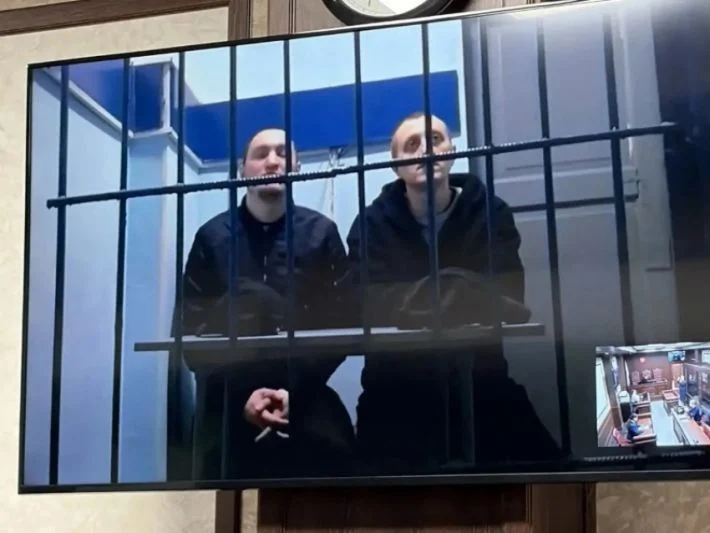
Russia’s Southern District Military Court in Rostov-on-Don has handed down one of the harshest sentences in recent cases linked to occupied Ukrainian territories. Ukrainian citizen Denys Hlushchenko and Russian citizen Aleksandr Malyshev, both detained in occupied Mariupol, were sentenced to 26 years in a penal colony on charges of alleged “espionage,” “participation in a terrorist group,” and assisting in directing strikes against Russian military targets.
According to Russian security agencies, the two men allegedly established contact in 2022 with Ukraine’s Defence Intelligence representatives in occupied Melitopol. They were accused of collecting coordinates and passing information to the Ukrainian military, which Russian investigators claim contributed to a strike on the building of a college in Melitopol. The facility was reportedly being used by Russian forces as an operational headquarters for the FSB.
No independently verifiable evidence has been publicly presented by Russian authorities, leaving the accusations in line with a broader pattern of politically motivated prosecutions against civilians and activists in occupied territories. International observers have repeatedly warned that Moscow uses broad terrorism and espionage charges to criminalise cooperation with Ukrainian institutions and to silence local communities.
The case is not an isolated one. Behind the verdict lies a wider crackdown on individuals connected to the Telegram channel “Melitopol Is Ukraine,” which served as an information platform for residents under occupation. In August 2023, Russian forces carried out large-scale searches and arrests targeting the channel’s administrators and contributors.
Among those detained were Hlushchenko and Malyshev, as well as Vladyslav Hershon, Mark Kaliush, Maksym Rupchev, and Yana Suvorova. Some remain in Russian custody, while others were later included in prisoner exchanges.
One of the most notable cases is that of Mark Kaliush, who was released together with UNIAN journalist Dmytro Khyliuk during a prisoner exchange on Ukraine’s Independence Day, 24 August 2025. Khyliuk had spent three and a half years in Russian captivity.
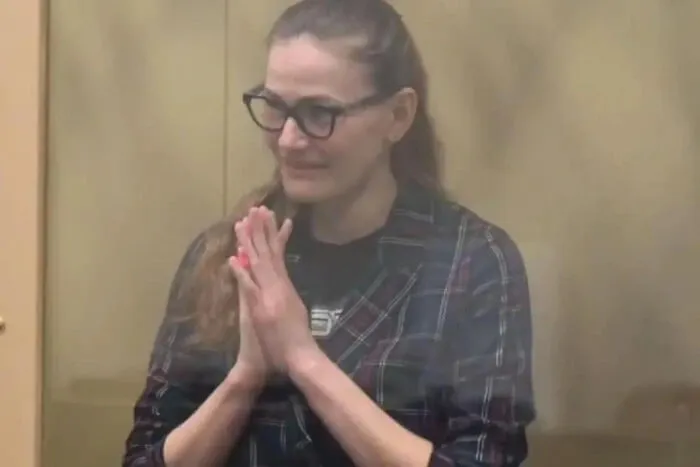
Yana Suvorova has become a symbol of the brutality of Russia’s repressive system. Russian authorities imprisoned her at just 18 years old, and her case drew outrage among Ukrainian and international media circles.
The sentencing of Hlushchenko and Malyshev further demonstrates how Russia’s judicial system in occupied territories functions as an extension of its military apparatus. These lengthy prison terms are not only punishment for individuals, but also a warning to all residents under occupation that any contact with the Ukrainian side can be labelled as terrorism.
In recent months, the Southern District Military Court in Rostov-on-Don has issued several similar verdicts against Ukrainian prisoners of war and civilians. Critics argue that this reflects the systematic use of the judiciary as a tool of repression, allowing Russia to tighten control over occupied territories while legitimising political persecution under the guise of counterterrorism.
 style="height: 190px; object-fit: cover;">
 style="height: 190px; object-fit: cover;">
 style="height: 190px; object-fit: cover;">